Why We Build Playbooks Before We Build Anything Else
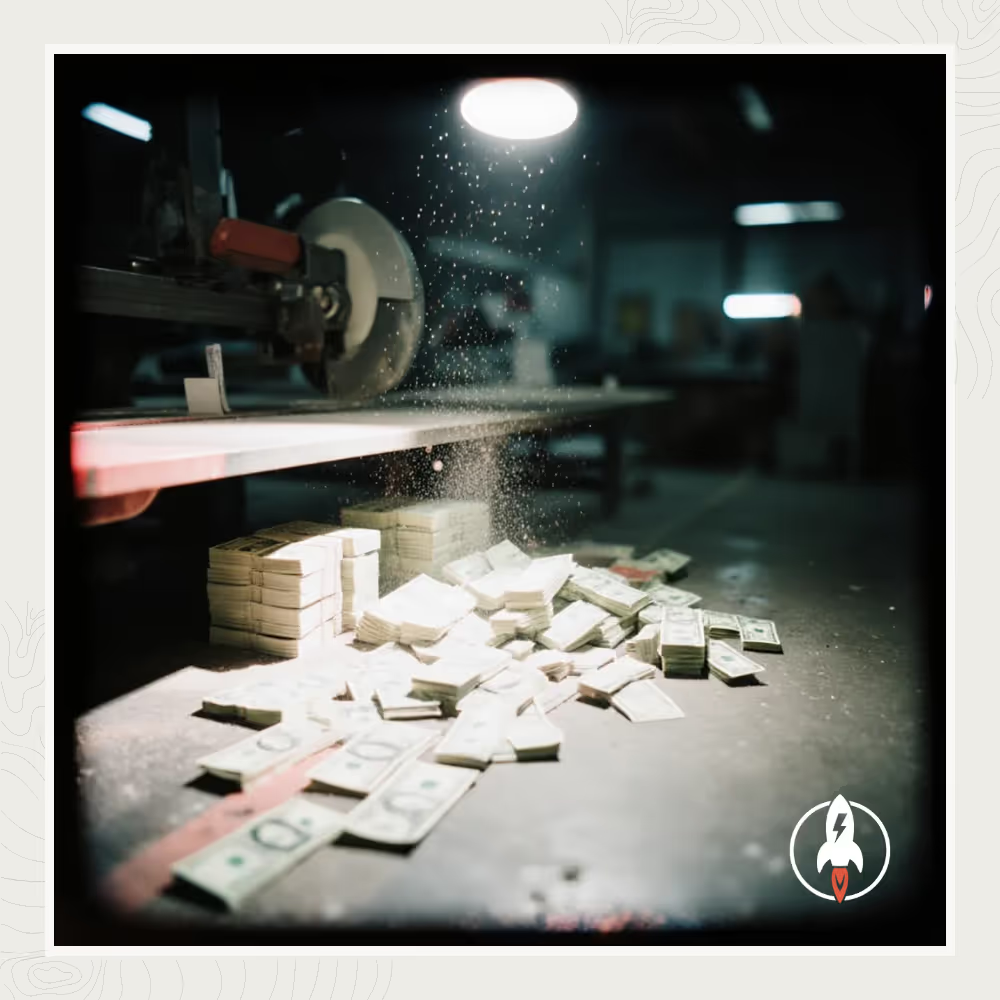
You can't keep cutting the same board and expect it to fit. Rocket Farm measures ten times to cut once; here's why playbooks are the foundation of everything we create.

When your internal content lacks alignment, your team notices.
It signals a lack of clarity. If your organization cannot speak with one voice, it suggests the strategy itself might be unclear. Teams may start to wonder if leadership knows where things are headed or if they even believe in it themselves.
It creates friction. Inconsistent content means every team is starting from scratch. No shared templates. No unified messaging. No clear standards. That inefficiency can compound quickly across any organization or team.
It weakens your internal brand. Your employees are your first audience. If the content they see every day feels disjointed or generic, it undermines the culture you are trying to build. In otherwords, your customers are downstream from your employees –– and if your employees are confused on the messaging, they’ll only amplify that dissonance. People disengage when they do not see intention behind the communication, so think about how that ripples to your customers/clients.
You know that old saying, measure twice, cut once? We don’t follow it.
At Rocket Farm, we measure about ten times. Maybe more. We test the angles. We check the grain. We make absolutely sure we know what we are building before we start cutting. Because here is the thing. You only get so many cuts before you run out of material. And in creative work, running out of material means burning through budget, missing deadlines, and delivering something that does not actually work.
Let me tell you what usually happens when people skip this step. Someone has an idea. They get excited about it. They want to move fast. So they skip the planning and jump straight into execution. Then halfway through, they realize the idea does not quite work the way they thought it would. So they adjust. Then they adjust again. Then they are redoing entire sections because the foundation was never solid to begin with. By the time the project is done, they have spent twice as much time and money as they should have. And the final result still feels a little off because it was built on guesses instead of a plan.
This is what happens when you measure once and cut twice. Or three times. Or ten times. Eventually you are just patching holes and hoping it holds together. I have watched organizations do this over and over. They launch without defining, so every piece of content ends up sounding different depending on who wrote it. They roll out a video series without a clear content strategy, so half the videos do not connect to anything else they are doing. They start posting on social media without a plan, so it is just random content that does not build toward anything meaningful.
Then six months later, they are frustrated because nothing feels cohesive. So they bring in someone like us to fix it. And you know what the first thing we do is? We stop everything and build the playbook they should have had from the beginning. It is like trying to build a house after you have already poured a crooked foundation. You can fix it, but it is going to cost a lot more than if you had just measured correctly the first time.
So what is a playbook anyway? It is not a restriction. It is a foundation. Think of it like this. If you are building a house, you do not just start nailing boards together and hope it turns into something livable. You draw up plans. You figure out the structure. You make decisions about load-bearing walls and electrical and plumbing before you pour the foundation. A playbook does the same thing for creative work. It is the set of decisions you make upfront so that everything you build later actually fits together.
When we start a project at Rocket Farm, the first thing we do is slow down. I know that sounds counterintuitive when everyone wants to move fast, but it is the most important part of the process. We do not jump into creative. We do not start designing or writing or filming. We sit with the problem. We ask a lot of questions. We figure out what actually needs to happen before anything gets made. That process looks different depending on the project, but it always involves the same core idea.
Once the playbook is built, everything gets faster. Revisions get lighter. The work feels more cohesive.
So why ten times instead of two? Because creative work is expensive to redo. Not just in terms of money, but in terms of time and momentum and trust. When you launch something that does not work, you lose credibility with your audience. When you have to redo a project because the strategy was not clear from the start, you burn out your team. Measuring ten times means we are thorough.
Here is a simple test. If you are about to launch something new, ask yourself if you have a playbook. Are you rolling out a new internal communications strategy? Do you have a messaging framework and a content plan, or are you just going to start sending emails and hope they work? Are you creating video content? Do you have a format, a structure, and a clear idea of what success looks like, or are you just going to shoot something and figure it out in post? Are you refreshing your brand? Do you have a voice guide and a visual system, or are you just going to make it up project by project?
If the answer is the latter, stop. Build the playbook first. We can help with that. That is literally what we do best. Because you can keep cutting the same board and hoping it eventually fits. But eventually, you are going to run out of material. Book a discovery call and let's build you a playbook that gets it right the first time.